

Inheritance

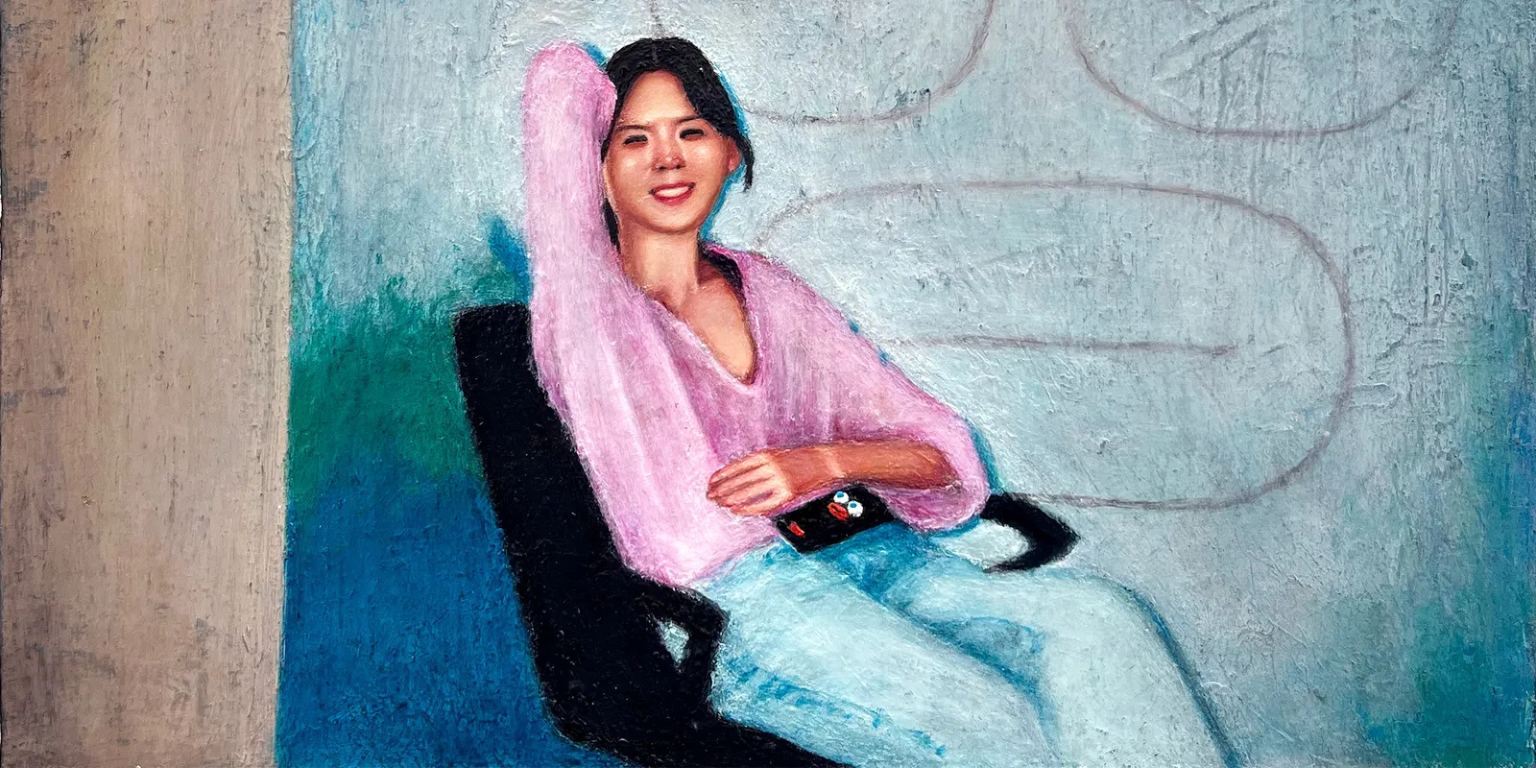
Emily Weiner, How the Light Gets In, 2026
I set up an automation in Claude Cowork this week.
A my dear friend Marina shared five principles from Raising A Strong Daughter in a Toxic Culture by Meg Meeker. They resonated so deeply I immediately configured a system so that every 4 months, these takeaways would land, cleanly summarized, on my desktop. A reminder, delivered on a schedule, so I don’t forget what matters.
I didn’t register the irony until later: I used AI to automate the delivery of a message about being present for my daughters.
I’m not going to resolve that contradiction here, and I’m not sure I can.
My original compass in life was built in a different world.
I mean this literally. The framework I relied on for determining what was worth my time and when I was living in alignment was forged long before:
-
Large language models (ChatGPT, Claude, Perplexity etc.)
-
The attention economy reached full saturation (a twelve-year-old could have a more sophisticated digital life than most adults managed at thirty.)
-
I was a mother.
Motherhood was the main driver mandating I rebuild my compass: mostly by failing at following the old one. The old one said: produce measurable outputs, earn external validation, keep the zoetrope spinning. It worked until my second matrescence journey dropped a 100lb anvil on it and it shattered. What followed were years of disorientation and reconstruction that I’ve been documenting in this newsletter since January.
I’m still in it. And I’m really liking how the compass is getting rebuilt.
The question I can’t stop sitting with is this: what compass do I hand my daughters?
I have been reading and listening to a lot of Daniel Schmachtenberger lately. What a name, right? He’s a systems thinker who has dedicated his life to what he calls the Metacrisis — the convergence of forces that could either destroy civilization or calcify it into something unrecognizable.
One of those forces is what he calls rivalrous dynamics: win-lose games where one party’s gain requires another’s loss. The attention economy runs on rivalrous dynamics. So does most of the achievement infrastructure we’ve built for children — the grades, the rankings, the college admissions gauntlet. Even the social hierarchies that form in middle school hallways.
I have a seven-year-old and a four-year-old. They are, right now, still largely untouched by this. I want to protect that, but I am not naive enough to think I can for long.
Sure: too much screen time and exposure to social media make me nervous, but Meta and YouTube are getting their comeuppance. Organizations like Mothers Against Media Addiction (MAMA) are fighting back and winning.
What I’m actually afraid of is that my daughters will grow up into a world that has automated away the very friction that makes life feel meaningful.
I’m afraid they will look back at my generation, at me specifically, and they will be so angry.
They will blame my generation for struggling with finding purpose.
They will argue that we solved all the wrong problems.
A creator I admire, DAN KOE, recently wrote that meaning is the experience of ordered consciousness — that it emerges when attention is invested in something complex enough to fully engage you. A challenge that meets you at your actual edge with the feeling of I’m not sure I can do this, but I’m going to try.
We know this as parents. We’ve watched our children learn to walk, to read, to navigate a conflict with a friend (or with us!) The struggle is the development.
But we’re living inside systems that are optimizing the struggle away. And I am not exempt from this!
It has NEVER been a better time to be a founder. I am using the tools right now to build my company faster than I could alone. I don’t say this lightly: claude may not be my my cofounder, but it is my Chief of Staff.
So when I try to imagine being the filter to my daughters in this age of AI, helping them build their compasses, I keep running into the same problem. The filter only works if it has a clear signal to pass through and my own signal keeps getting complicated by my own complicity.
I don’t have clean hands here. (I’m not sure any of us do.)
Here’s what I know, or at least what I’m working with right now.
The framework I’ve been building — in this newsletter, in Mother of Invention, in my own parenting — is fundamentally an argument against optimization. The thesis is: the diaper change matters. The repetitive, unglamorous, friction-full moments of caregiving of early childhood are not to be eliminated or rushed through with gadgets, gizmos and an AI automation mindset.
These are the moments where attachment bonding and brain development live. These moments are where a child learns that someone will show up, not just for the good parts, but for all of it.
The framework itself is what I can pass down to Sarah and Sammy. I want this framework to help them practice staying inside the hard things. Being in the discomfort long enough to let is deepen into wisdom and truth. Not reaching immediately for the tool that makes the friction disappear.
Being willing to not know.
Fundamentally, I can’t hand my daughters a compass. I can only model how to build one. And rebuild one when a 100lb anvil smashes their current one.
I think this means they need to watch me wrestle with this, openly, without pretending I’ve resolved it.
Thanks to Claude Cowork: that email automation reminding me of the 5 key takeaways from Raising A Strong Daughter in A Toxic Culture will arrive at 9am PST, four months from now.
And I will read them again, and I will try again to 1) be my daughter’s anchor 2) define strength on my own terms 3) hold the line with love 4) separate worth from performance 5) be the filter of culture.
I think there’s something a child inherits not from the answers her mother has, but from watching her mother refuse to stop asking the questions.
I hope so.
- Maggie


Enjoyed this essay?
Subscribe to Soft Geometry for a thoughtful new reflection every week.


CONTACT
PRIVACY
© Mother of Invention