
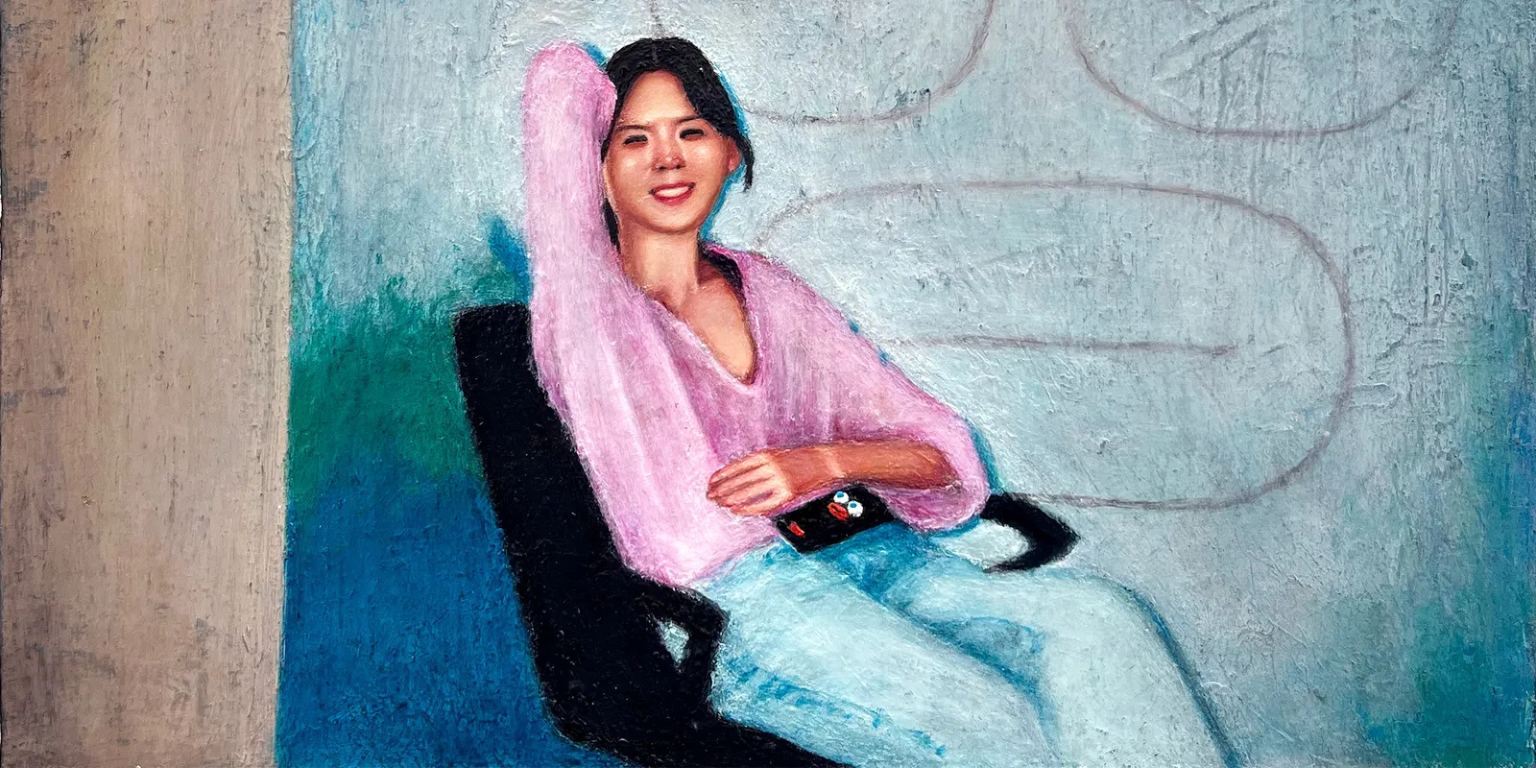
The Stolen Phone
How many times did I go on a quick end-of-day stroller walk and make it all the way around the block and not remember a step of it?
Strollers are no longer a part of my parenting routine with 4 and 7 year olds, but I remember countless one-handed strolls when I would be responding to emails or texts or DMs. Or scrolling on Instagram.
While my daughter faced forward in the stroller gazing at the trees, the dogs, the streetlamps, I would be somewhere else entirely.
Cue the guilt.
How many times did this happen? No idea. And that's the thing about autopilot: you don't notice it while you're in it. You just arrive at the end of the block as the sun is setting and realize the walk is over and you weren't there for any of it.
My baby and toddler daughters didn't know. They were happy enough, pointing at things and probably having conversations with themselves.
But I knew.
I want to name what was actually happening on those walks, because I don't actually think it was a personal failing.
The attention economy is a set of systems — designed by some of the smartest engineers in the world, optimized by algorithms that learn faster than we can adapt as humans — whose explicit purpose is to capture and hold human attention.
Every notification, every frictionless scroll, every pull-to-refresh is the product of deliberate design. Not always malicious design for adults, but for children? That's an essay for another day.
Attention economy design, however, is fundamentally indifferent to whether the thing competing for your attention is an email or a child.
The attention economy doesn't know you're on a walk with your daughter. It just knows you picked up your phone and your attention is up for grabs.
And here's the part that doesn't get said enough: this isn't a willpower problem. Blaming yourself for checking your phone while your toddler plays is like blaming yourself for being hungry near a bakery. The smells wafting off a bakery are naturally designed to make you hungry!
Your phone was designed to make you reach for it. The pull is engineered, but the guilt is yours… which is not fair.
And also not especially useful to dwell on, in my opinion.
These days my daughters figure out the solution for me: they steal my phone.
Not to use it — know they are not allowed to take pictures or do just about anything with it. They take it because they understand with the particular clarity that small children have about what they need, that my phone is often their competition. Remove the competition? Get the mommy.
And it's kind of precious how they orchestrate their thievery: Sarah (7yo) is subtle about it… she slides it off a pillow and let's it drop in between sofa cushions. Sammy (4yo) is less subtle. She grabs, it runs, squeals and turns it into a game of high stakes chase.
I always chase her because there is a not an unlikely chance her undeveloped prefrontal cortex will not limit her from throwing it in the toilet.
And for the thirty seconds of the chase, I am completely, entirely present.
When my daughters start to do this, I know my iPhone boundaries are getting a little fuzzy and I need a reset.
So how do we combat the attention economy and convert it into the meaning economy?
What is the meaning economy? Again, thanks to Dan Koe, this term is part of my vocabulary and it is hyper relevant to parenting. Here's some context:
Meaning is the scarcest commodity in civilization right now. Before industrialization, we praised Gods in the sky. During industrialization, we made productivity our God. Today, more is our God. More money, more information, more content. We have more stuff and less purpose than ever.
Here's how he defines it:
When attention is fragmented, scattered, and pulled in competing directions, that's psychic entropy. It feels like anxiety, boredom, and restlessness. Chaos. When attention is invested an activity with clear feedback, that's psychic negentropy. It feels like flow, purpose, and meaning. Order.
(Can you tell DAN KOE and I are both students of Mihaly Csikszentmihalyi?!)
So… if meaning is the process of reordering consciousness… and we have this powerful device that is constantly demanding our attention… what's a mom to do?
Here's the iPhone reframe I've been sitting with, and I'll warn you it's a little counterintuitive:
Don't put away your iPhone.
I would argue your iPhone is actually one of the best parenting tools in your house. We just have to start using them to create enough fencing to hold back the attention economy and create space for meaning.
Remember the concept of special time?
Try this: next time you want to play with your child or want to imbue a diaper change with more ritualistic meaning do this:
Pull your phone out, put it on "do not disturb".Open the clock. Set a five-minute (or whatever time you want!) timer. If your child is old enough to perceive "special time", let them push the start button.Then slip it into your pocket, face down, out of sight.
Now you are timeboxed: time to play. For kids, it's brain development, attachment bonding and so much more. For parents, it's a form of meditation when you can commit.
You have created the parameters: the challenge is to not use your iPhone. To immerse yourself so fully in your child, in whatever you're doing, that you lose sense of self and time.
You've removed the ability for the attention economy design to hook you back in with "do not disturb".
And when the timer goes off? Give yourself a genuine pat on the back. You just gave your child five minutes of what developmental neurobiologists call parent-child synchrony — the attuned, responsive, back-and-forth interaction that builds secure attachment and drives brain development.
Turn "do not disturb" off and voila, it is now back in "attention economy" mode.
The phone isn't the villain.
The attention economy has a parenting problem, but it's not the one we usually talk about.
We talk about screen time. We talk about kids on devices. We have apps that limit apps and podcasts about digital wellness and books about raising children in a toxic culture — and all of that matters, genuinely.
But the quieter problem, the one I lived on those walks around the block, is what the attention economy does to the parent. How it trains us, gradually and without our consent, to experience caregiving as interruption. To feel the slow, repetitive, unglamorous moments of early childhood as dead time — time in which we could be doing something else, something that produces a measurable output, something the world will actually notice.
The diaper change interrupts the email. The walk interrupts the Instagram post. The five-minute block game interrupts the zoom.
Except it doesn't. The interruption is the thing. The diaper change, the walk, the block game — these are not the gaps between your real life. They are your real life. They are certainly your child's real life, happening right now, unrepeatable, in front of you.
The attention economy just forgot to mention that.
My daughters still steal my phone sometimes. I've started letting them keep it longer than necessary, because something about the chase that follows — the shrieking, the running, the catching, the collapse into tickling — is worth more than whatever I was about to do with it.
The phone will still be there. The red-bellied robin perched on the neighbors fencepost at dusk, perceived through two-year-old eyes on a Sunday evening stroll? That one's already gone for me.
I'm trying to be there for more of the unrepeatable ones.
- Maggie



Enjoyed this essay?
Subscribe to Soft Geometry for a thoughtful new reflection every week.


CONTACT
PRIVACY
© Mother of Invention